Sometimes, the most strategic move a founder can make is to deliberately kill the project they love the most.
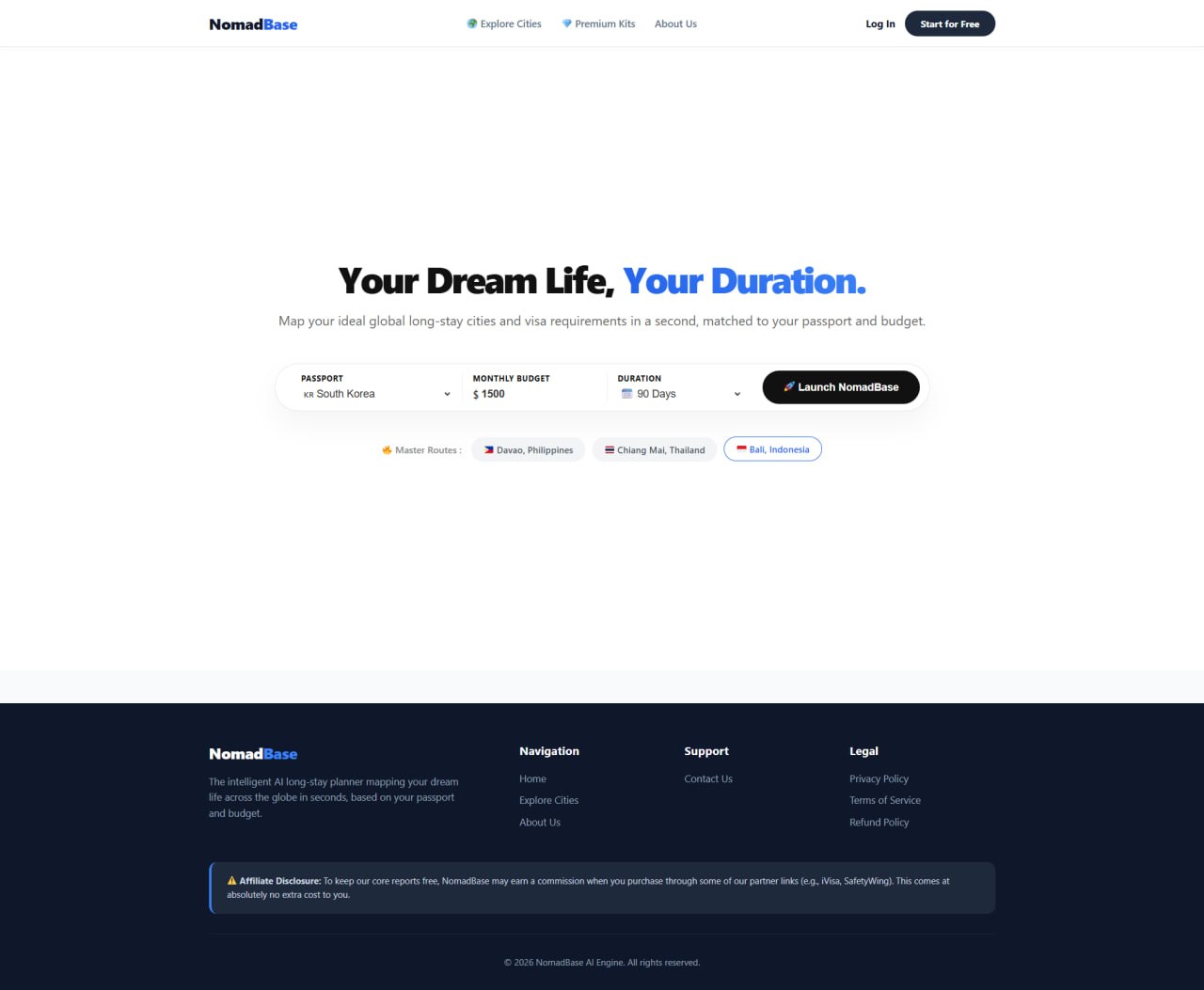
Let me paint you a picture. The screen loads, clean and minimalist. A stunning backdrop of a cityscape at dusk. The words “The life you dream of, for the duration you want” hang in the air, a promise of freedom. Below it, a few simple fields: your passport, your monthly budget, your desired stay. And one single, powerful button: “Launch.” This was Nomadbase. It was designed to be the definitive answer for a new generation of global citizens, an AI-powered compass for the digital nomad. It was born from my own deepest ambition: to build a life where all I needed was a laptop and an internet connection to work and thrive, anywhere in the world.
The idea wasn’t conceived in a boardroom or a brainstorming session. Like its sibling project, Vitabase, Nomadbase was born in the gaps—the minutes and hours of dead rendering time while my main AI engine, VertiqAI, churned through complex tasks. In those moments of forced stillness, my mind would race. I saw a massive, accelerating trend: the rise of the digital nomad, the evolution into “Slomading” (long-term stays in a single location), and the chaotic mess of ever-changing visa regulations. The market research was more than validating; it was a siren’s call. A projected 11.7% compound annual growth rate in the digital nomad market confirmed I wasn’t just building a tool for myself; I was tapping into a cultural seismic shift. I bought the domain. I wired up a basic landing page. The dream had a name and a home on the web. And for a while, it felt perfect.
The Long Drive and the Three Pillars of Failure
The decision to put it on ice didn’t come from a spreadsheet. It came during a long-haul drive, one of those rare occasions where you’re disconnected from screens and forced to be alone with your own unvarnished thoughts. As the miles of highway blurred past, the elegant logic of Nomadbase began to fracture under the weight of reality. The “perfect idea” revealed itself to be a labyrinth of intractable problems. No matter how I mentally navigated the maze, I hit the same three walls, again and again.
The first wall was the competition. It’s one thing to say you have competitors; it’s another to truly internalize that you’re a rowboat trying to cross an ocean filled with battleships. I wasn’t just competing with one or two startups. I was taking on the entire ecosystem. The established giants like Nomad List with its decade of community-sourced data and network effects. The booking behemoths like Kayak and Skyscanner with their impenetrable affiliate partnerships and billion-dollar marketing budgets. And most critically, the primary sources themselves—the labyrinthine but official government websites that hold the ground truth on visa laws. What did I have to fight them with? A clever idea, some coding skills, and a non-existent budget. I had no technological moat, no capital advantage, and—if I’m being brutally honest with myself—no unique founder ability that would let me outmaneuver them all. It was an unwinnable war from the start.
The second, and perhaps most decisive, wall was monetization. A cool project is a hobby; a business needs to make money. Every path I explored led to a dead end. Offer visa agency services? The information is largely commoditized. In an era of ChatGPT and instant search, who would pay a middleman for information that is, ultimately, public? Even worse, my target audience—tech-savvy digital nomads—are the absolute last people on earth who would pay for this. They are expert-level researchers, power users of AI, and fiercely independent. They would see a paid visa service as a tax on the lazy. What about a premium membership for curated information? The data I planned to crawl and aggregate could, with a bit of focused effort, be replicated by anyone with moderate technical skill. I’d be selling a convenience, not a necessity, to a user base that prides itself on resourcefulness. Affiliate revenue from flights, insurance, and accommodation? A fool’s errand. I would be a minnow fighting sharks for scraps in the hyper-competitive SEO waters of the travel industry.
The Crushing Weight of a Single Error
But the third wall was the one that truly sealed the project’s fate: the catastrophic liability of being wrong. This wasn’t a social media app where a bug might cause a loading error. The data for Nomadbase—visa laws, tax treaties, public safety metrics, cost of living—had to be perfect. Not just accurate, but real-time, infallibly perfect. My system would be built on web crawlers, and crawlers can fail. APIs can change. A government can update a single webpage about visa-on-arrival policies without any announcement.
Let the full weight of that sink in. Imagine a user trusts my platform. They see that my AI has given them the green light for a six-month stay in a specific country. They quit their job, sell their belongings, book a one-way ticket, and land in a foreign airport, only to be denied entry because my crawler missed a regulatory update that went live 48 hours earlier. Their life is thrown into chaos because of my code. Or worse, imagine my system flags a neighborhood as “safe” based on data that is three months out of date, and a user, trusting my platform, becomes a victim of a crime. The potential for doing real, life-altering harm was staggering. It’s a legal and ethical nightmare that I, as a solo founder, have absolutely no capacity to shoulder. The risk wasn’t just business failure; it was the potential to ruin someone’s life. I couldn’t build a business on that foundation.
A Strategic Retreat, Not a Surrender
So, Nomadbase is officially shelved. It’s a painful decision, especially for a project I’d invested so much thought and hope into. But this isn’t a total loss. This is a strategic retreat. In the startup world, you learn that every line of code, every workflow, every domain name is an asset that can potentially be repurposed. The core n8n automation I built to crawl complex government websites and structure that data into a clean database is incredibly robust. That logic is now being ported over to Vitabase, where it can be used to gather market intelligence and track industry data. The asset finds a new, more viable home.
And what about the domain, `Nomadbase.com`? I’m not letting it go. I’m setting it up with the same automated blogging system that runs my Techhustledaily site. For the next six to twelve months, it will quietly publish relevant content, building SEO authority and aging like a fine wine. It requires zero active effort, but it transforms a dead asset into a potentially valuable one. If the market shifts, or if I find a new, viable angle in a year, I won’t be starting from scratch. I’ll be starting with a domain that has history and traffic. For now, Nomadbase goes into the vault, a project in cryosleep. It’s a testament to a great idea that crashed against the brutal shores of reality. And while it stings to close that chapter, the lessons learned—and the code salvaged—will make every future project stronger.

“True automation isn’t just about building new things; it’s about efficiently salvaging the valuable parts of what you must tear down.”
1 thought on “[Nomadbase]The Hardest Decision: Shelving the Dream I Still Believe In”