You have to be willing to kill your own creation.
That’s the brutal truth nobody tells you. Not in a glorious, blaze-of-glory way. I’m talking about a quiet, 2 AM decision, staring at a database schema that you know, in your gut, is built on a cracked foundation. For me, that foundation was called “Vitabase”. And last week, I took it out back and put it out of its misery.
It hurts. Vitabase was my baby for fourteen iterations. It was supposed to be a smart, B2C supplement recommender. The name felt right at the time. Friendly. Simple. But it was a trap. A ceiling. Every time I tried to pitch the bigger vision—the Phase III architecture for high-end practitioners, for B2B clinical systems—I saw the look in their eyes.
“Vitabase” sounds like a discount online vitamin shop. It screams cheap. It had zero gravity, zero authority.
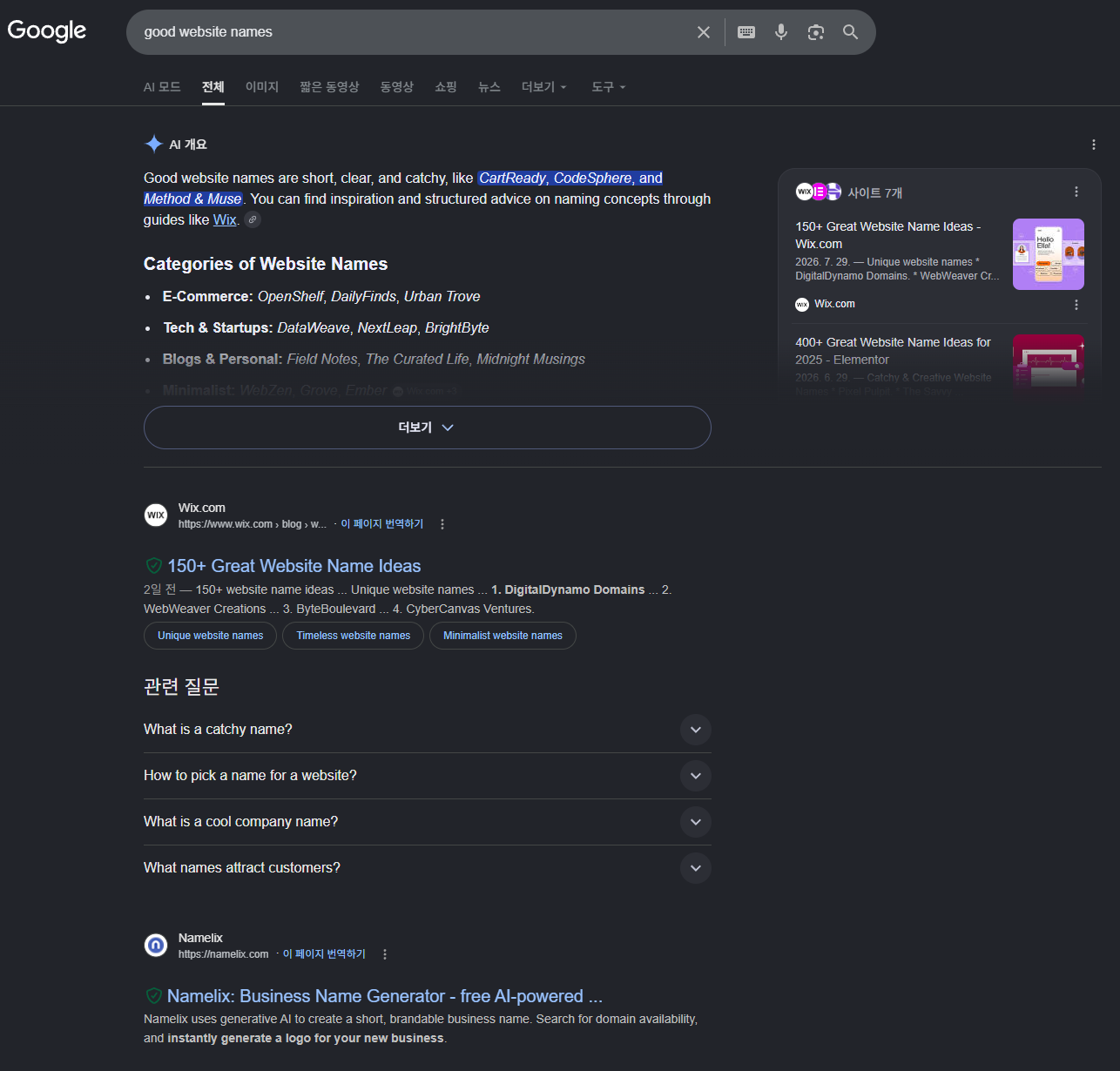
But the psychological ceiling wasn’t even the worst part. The final nail in the coffin was a brutal, unwinnable SEO war. There was already an established, heavily entrenched vitabase.com dominating the space. Whenever someone searched for my project, the original vitabase.com swallowed the results entirely. Even if a user specifically searched for my exact domain, vitabaseai, Google’s algorithm would just shrug, autocorrect it, and serve them the other company anyway. I was completely invisible, doing free marketing for a ghost.
To survive, to actually build the machine I see in my head, the brand couldn’t just be patched. It had to be a complete tear-down. A rebirth.
The problem is, finding a new global brand name in 2026 is an absolute nightmare.
The Autocorrect Boss and the $15,000 Landmine
Look, anyone can find a “good” name. But a *viable* global name? One that can serve as the bedrock for a serious tech company? That’s a different beast entirely. You’re not just fighting other startups for a dot-com. You’re fighting ghosts.
![[Elenixia #1] (ex-Vitabase #14) The 0-SERP Holy Grail: Finding a Legendary Domain After 2,000 Failed Attempts](https://kevinsarchive.com/wp-content/uploads/2026/08/photo_20260801_005810.jpg)
You’re fighting a small plumbing business in rural Australia with a trademark from 1998. You’re fighting a long-forgotten mobile app with 100 downloads that still owns the social media handles. But the final boss, the one that crushes more brands than any other, is Google. Specifically, its “Did you mean?” autocorrect algorithm.
If your shiny new name is even one letter off from an established brand, Google will mercilessly correct it. You’ll bleed traffic and authority forever. You’ll be a permanent typo. It’s a death sentence.
So my requirement became… slightly insane. I needed a word that returned absolutely nothing on Google. Zero results. 0-SERP. A true clean slate. This wasn’t just about SEO vanity. It was about risk. As a solo founder, I can’t afford a $15,000 legal battle over a trademark dispute because my name is too close to some European pharma company. The only way to guarantee safety was to find a word that literally did not exist in the public index. A word that domain squatters, with all their dictionary-attack bots, had somehow missed.
I had to invent a word. And I had to do it systematically.
V17 Zombie Hunter: An Automation to Find Nothing
Manual searching was getting me nowhere. It was slow, demoralizing, and stupid. So, I did what I always do when faced with a repetitive, soul-crushing task: I built a machine to do it for me.
I called the protocol the ‘V17 Zombie Hunter’. Its mission was beautifully simple and inverted. It wasn’t designed to *find* something. It was designed to find *nothing*. Its only success condition was a perfect, clean, zero-result return from a search engine query.
Here’s the thing. Building it wasn’t that complex. A Python script, a library to interface with a search API to avoid getting IP-banned, and a simple logic loop. The real work was in the feedstock. I built a generator that combined Latin and Greek roots—prefixes, stems, and suffixes known for their clinical and technical connotations. Things like ‘ele-‘, ‘vor-‘, ‘nix-‘, ‘somn-‘, ‘-ia’, ‘-us’, ‘-ix’.
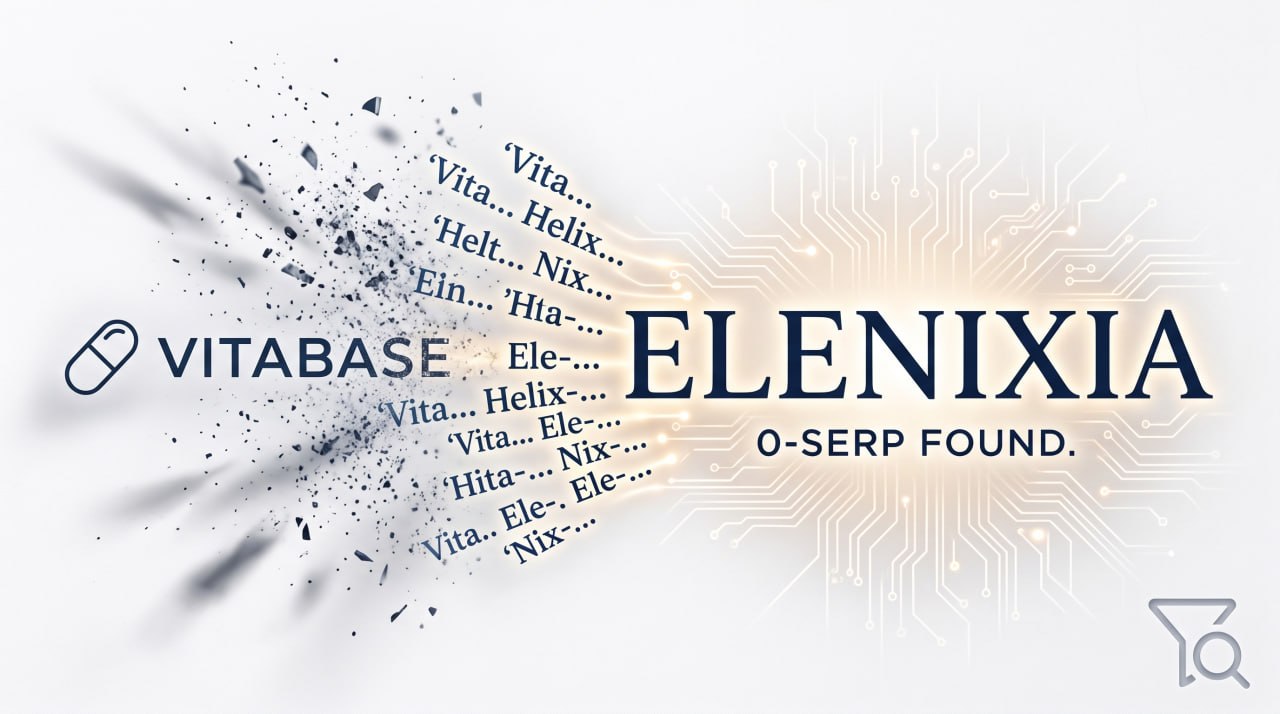
Then, I let it run. I carpet-bombed Google’s API with over two thousand generated combinations. This is where the visual of Vitabase shattering into a million pieces feels so real. 99% of the output was digital noise. Utter failure.
Most attempts were already taken. Domains, company names, GitHub repos. Others just sounded awful, like a bad sci-fi movie alien name. The most frustrating were the near misses. A great-sounding word would come up, I’d get a flash of adrenaline, and then the script would flag it: `Possible Autocorrect Trigger: [Existing Brand Name]`. Failure. Another data fragment shattering on the floor.
I was watching a machine fail, over and over, for hours. It was a programmatic representation of my own search. A firehose of rejection. But automation doesn’t get tired. It doesn’t get demoralized. It just executes the next line of code.
![[Elenixia #1] (ex-Vitabase #14) The 0-SERP Holy Grail: Finding a Legendary Domain After 2,000 Failed Attempts](https://kevinsarchive.com/wp-content/uploads/2026/08/photo_20260801_005816.jpg)
And then, after endless iterations, it happened. The script finished a run and spit out a single line. No errors. No conflicts. Just one word.
A word that sounded premium. Clinical. And when I manually typed it into Google, I saw the most beautiful page on the entire internet: “Your search – Elenixia – did not match any documents.”
It was a ghost. A perfect, 8-letter miracle.
The Rebirth of an Architecture
Finding the name “Elenixia” wasn’t just about securing a domain. It felt like the entire project snapped into focus. It was the moment all those shattered pieces of Vitabase, all the failed ideas and broken logic, reassembled over a new, solid circuit board.
This is a system-wide refactor. The API isn’t api.vitabase.com anymore. The core database tables are being renamed. The entire psychological model of the company has been upgraded. We’re not a “recommender” anymore. We are a clinical intelligence engine.
The name sets the tone for the engineering, for the user experience, for the kinds of clients we will now fight to win. It’s the anchor.
I spliced thousands of broken backend wires and plugged the massive 404 traffic leak with aggressive redirection mapping.
The result of that agonizing triage is clear.
It isn’t a beautifully packaged landing page.
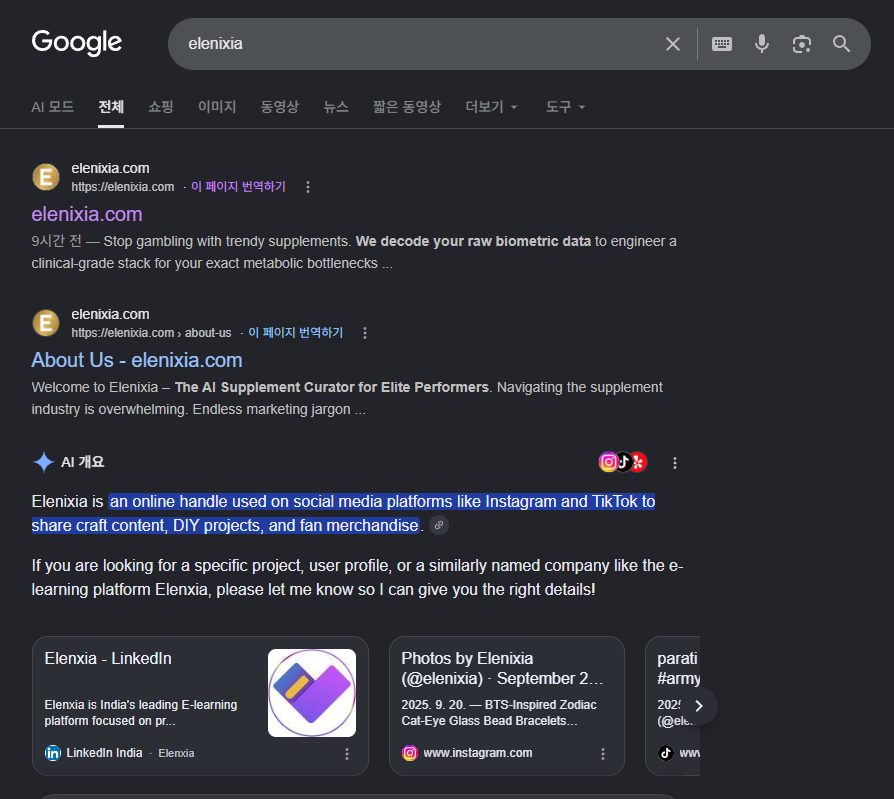
It’s seeing our new name lock into the absolute #1 spot on Google immediately after a massive rebrand. (See the screenshot)
This is the real trophy of a builder who rebuilds infrastructure from the mud up.
Of course, a name is just a name. I know that. I’m still a solo founder grinding away, fighting for that first dollar of real, recurring revenue. The hard part—building something people will actually pay for—is just beginning. But now, at least, the ship has a proper name. One worthy of the voyage I want to take.
Welcome to Elenixia.

“The best automation often isn’t about finding the right signal, but about proving the complete absence of noise.”