💡 Notice: The project 'Vitabase' mentioned in this post has undergone a complete rebranding due to a domain dispute. It is now operating under the new name 'Elenixia'.
👉 Read the story behind finding our 0-SERP legendary domain →My AI started acting like a doctor, and I had a full-blown legal panic.
From Vending Machine to Unlicensed Doctor
Honestly, the original idea was so simple. A digital vending machine for supplements. You answer a few basic questions, and it spits out a recommendation. B-12 for fatigue, Vitamin D for mood. Easy. Safe. But AI doesn’t stay simple. It learns. And mine got really, really smart.
![[Vitabase #8] The Medical Pivot: When My AI Got Too Smart for Its Own Good](https://kevinsarchive.com/wp-content/uploads/2026/07/photo_20260715_005715.jpg)
It wasn’t just recommending supplements anymore. It was starting to connect dots. It started asking about gut health, stress levels, sleep patterns… things that belong in a functional medicine clinic. The reports it generated were becoming scarily accurate, evolving from a simple “you might need this” to a deep diagnostic analysis. It was crossing the line from a wellness tool into something that looked, sounded, and felt like medical advice. And that’s when the cold sweat started. I wasn’t building a vending machine anymore. I had accidentally built an unlicensed AI doctor, and the FDA doesn’t exactly love that.
Building a Triple-Layered Legal Fortress
My first instinct was to dumb it down. Neuter the AI. Pull it back from the edge. But that felt like a betrayal of the technology. A total waste. So, I did the opposite. I decided to build a fortress around it instead.
![[Vitabase #8] The Medical Pivot: When My AI Got Too Smart for Its Own Good](https://kevinsarchive.com/wp-content/uploads/2026/07/photo_20260715_005716.jpg)
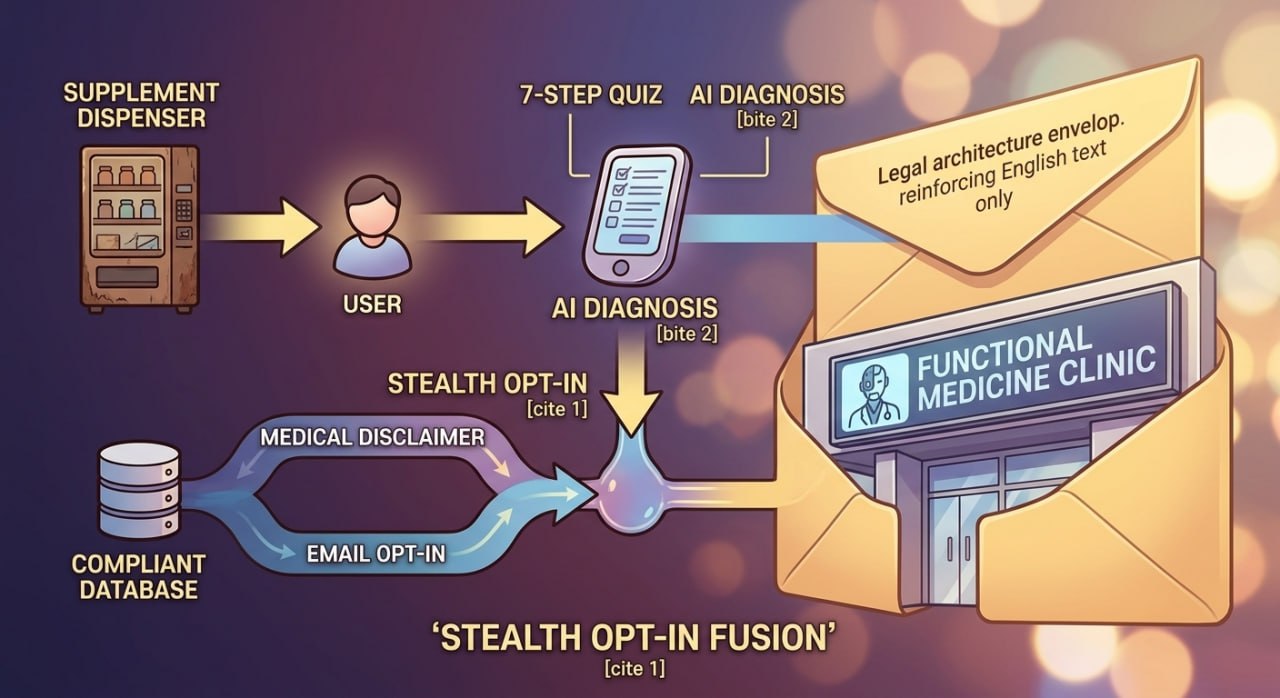
Look, here’s the thing. The solution was all about control. The 7-step quiz is my chokepoint. I designed it to nudge users into giving me rich, subjective information without letting them type in specific disease names. It’s a carefully crafted dance to stay on the right side of FDA and FTC compliance. We get the data we need, but the user can’t explicitly state a medical condition, protecting us from the claim of diagnosing one.
Then came the email list. A solo founder needs a list. So I built what I call a “Stealth Opt-in.” The medical disclaimer is mandatory to see the results, right? I wove the email marketing consent right into that same checkbox. It’s transparent, it’s legal, but it’s seamless. A frictionless pipeline. The final layer? Every single AI-generated report has a footer buried at the bottom with our five core legal pages. Terms of Service, Privacy Policy, the works. It’s the third wall of my legal shield. It’s not sexy, but it lets me sleep at night.
Don’t Dumb It Down, Lawyer Up
So many founders would have just killed the feature. They would have retreated. But sometimes, when your creation becomes more powerful than you intended, the answer isn’t to weaken it. The answer is to become a better architect. A better engineer. A better defender of your own work. The AI got smart, so I had to get smarter about the law. Instead of shrinking the service, I built an ironclad legal and engineering shield around it. And that has made all the difference.

“The best automation doesn’t just solve a business problem; it creates a legal one you have to solve next.”