
My payment system almost ate my business for lunch this week.
Honestly, I got cocky. I’m building this thing solo, grinding for every bit of traction, and you start to think you see the patterns. When it came to setting up B2B subscriptions, I thought, “Easy.” Get the payment, add the credits. How hard could it be? Just plug the ‘invoice.paid’ webhook from Whop into a Google Sheet and call it a day.
I was so wrong. It was a complete disaster.
The Data Started Vanishing
The first few signups went fine. Then the renewals started. And that’s when the nightmare began. My simple system didn’t know the difference between a new customer and a returning one. So when a monthly renewal payment came through, it would just overwrite the customer’s original record. Boom. Their credit history, gone. Or worse, it would create a totally new, disconnected row, orphaning their old data.
It got even messier. Someone upgraded their tier. The system completely lost its mind. Data was getting corrupted, tangled, and credits were just evaporating into thin air. I was watching my tiny, hard-won customer database slowly destroy itself with every successful payment. It was a ticking time bomb I had built myself.
![[Elenicixa #15] The Whop Labyrinth: How a Payment Webhook Almost Nuked My Entire Database](https://kevinsarchive.com/wp-content/uploads/2026/08/photo_20260810_142349.jpg)
One Webhook, Four Realities
Look, when you’re a systems engineer, you don’t panic. You dig. I stopped everything and just stared at the raw data coming from the Whop webhook. And there it was, hidden in plain sight. A little property called ‘type’.
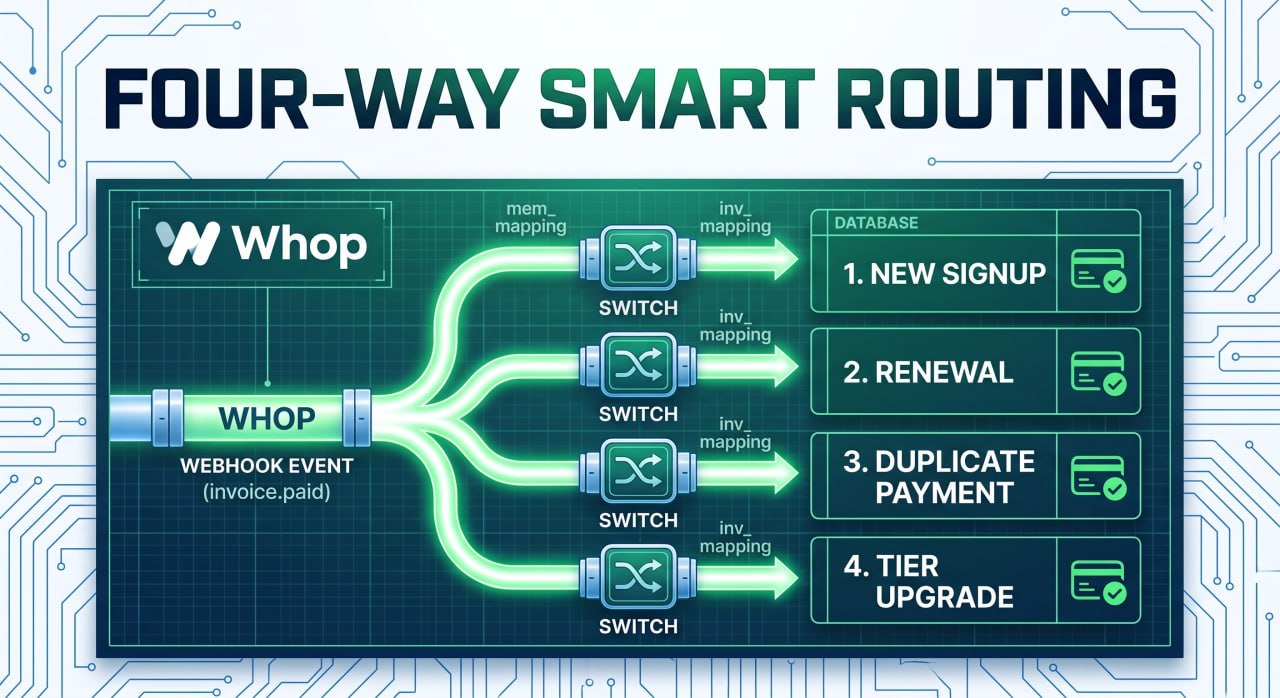
It turned out ‘invoice.paid’ wasn’t a single event. It was a category. A single payment could mean four completely different things:
- A brand new customer signing up.
- A routine, monthly renewal for an existing customer.
- A customer changing their subscription tier.
- A weird duplicate event I needed to filter out.
The single road I’d built was actually a four-way intersection with no traffic lights. No wonder everything was crashing.
So I built the traffic lights. I designed a 4-way switch router. Now, when a payment comes in, my system doesn’t just blindly write to a database. It first asks, “What *kind* of payment are you?” As you can see in the diagram, it channels the data down one of four specific paths, each with its own logic. It protects the existing customer ID, safely maps the new invoice, and makes sure every credit goes exactly where it’s supposed to. It’s not just a webhook anymore; it’s a proper, resilient system.
This whole mess was a brutal lesson. I’m still fighting for my first real MRR, and a mistake like this could have been the end. You can’t just plan for the happy path where money shows up perfectly. You have to plan for the human chaos—the changes of mind, the renewals, the edge cases. That’s the real work of automation.

“Real automation isn’t about handling success; it’s about controlling the chaos when money actually starts moving.”